
Splicing
Splicing rope means working the strands or braid back into the rope itself, instead of tying a knot, to make a permanent joint or an eye (an eye splice). Made according to the manufacturer's instructions, a splice often reaches 90–100 % of the rope's breaking load, depending on rope, diameter and splice type; splices that are too short, considerably less. Usual knots keep less.
Splicing is part of rope and rigging work. The technique depends on the rope construction: laid rope, double braid (core and cover), or braid without a cover. Typical fibres are polyester, polyamide and HMPE (Dyneema); in addition there are natural fibres, polypropylene and aramid and Vectran. How much of the breaking load remains usable after the splice depends on the execution and the method.
Splicing is to be distinguished from knots, rope clamps, swage sleeves and whipping, as well as from the splicing service as a paid service and from fibre-optic splicing, which uses the same German name (Spleißen) but belongs to a different field.
- Last reviewed
- · Hamburger Tauwerk Fabrik · Review cycle: semi-annual
Splicing: key facts
- In brief
- Load transfer through friction and positive locking in the interwoven rope, without a knot
- Also known as
- Splicing, Spleissen (German variant spelling), Spleißen (German), rope splicing
- Result
- Permanent end termination, eye termination or rope-to-rope joint
- Field
- Rope technology, rigging, running rigging
- Applies to
- Technical fibre ropes, natural fibre ropes and wire ropes, used among other things in yacht rope as well as swings and climbing ropes. Fibre ropes in three constructions: laid, braided double braid (core and cover), braided without a cover.
- Related shop areas
- Rigging tools, Halyards and sheets, Mooring lines, Ropes & fibre ropes, Wire rope
- Not to be confused with
- Individual splicing instructions, the splicing service, knot craft or swaged connections. This is not an approval for load-bearing connections; the rope manufacturer's splicing instructions and the inspection of the finished connection remain decisive.
Splicing by rope construction
The splicing technique depends on the rope construction. For fibre rope these are laid rope, double braid (core and cover) and braid without a cover. Wire rope is a separate material group and not a fibre splice.
| Construction | Structure | Typical splice | Example |
|---|---|---|---|
| Laid | Strands twisted around one another, usually three-strand | Eye splice with hollow fid | laid polyester, polyamide or natural fibre |
| Braided, double braid (core and cover) | load-bearing core inside a protective cover | Core and cover are tucked back into each other, with a Selma needle or D-Splicer | LIROS Top-Cruising, halyards, sheets |
| Braided, without a cover | Hollow braid, usually 12-strand, no separate core | Bury splice, Brummel splice with a Selma needle or D-Splicer | LIROS D-Pro / Dyneema |
| Wire rope | Strands of wire, no fibre braid | dedicated wire splice or swaged sleeve / U-bolt clip | Stainless steel wire rope |
In its workshop, Hamburger Tauwerk Fabrik splices technical fibre ropes, natural fibre ropes and wire ropes. This is hand splicing according to rope construction and manufacturer instructions, not the same as a machine-spliced series end. In the yacht sector this includes halyards, sheets and mooring lines, and in the play and sport sector swings and climbing ropes. Climbing rope here means play and fitness ropes, not dynamic mountaineering climbing ropes.
Types of splice
The main load-bearing splices are the eye splice, the thimble eye splice and the endless splice. The execution depends on the rope construction, not on the name of the splice alone.
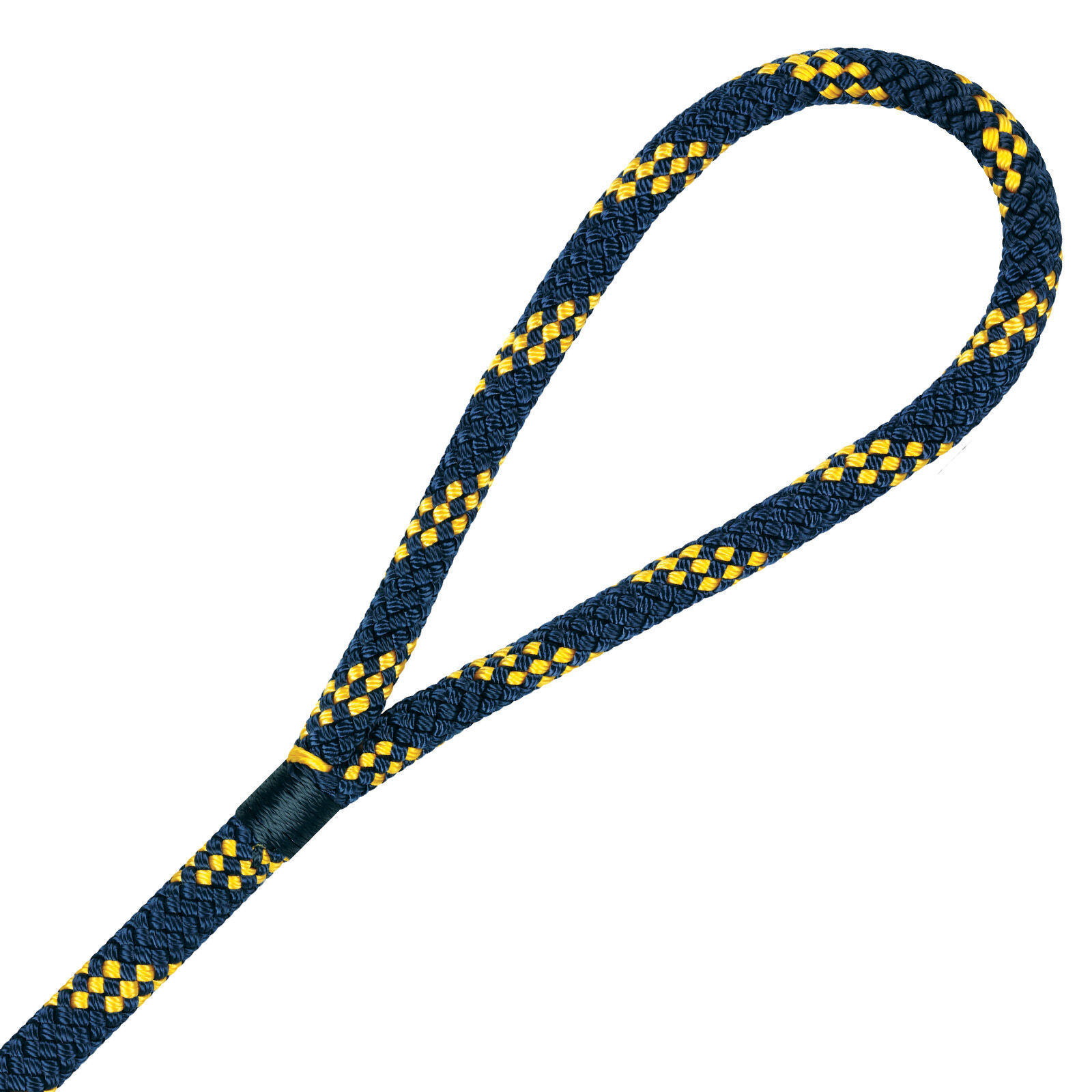
Eye splice
The eye splice forms a closed loop at the rope end for shackles, cleats, bollards or soft shackles. The eye stays flexible and has no metal insert.
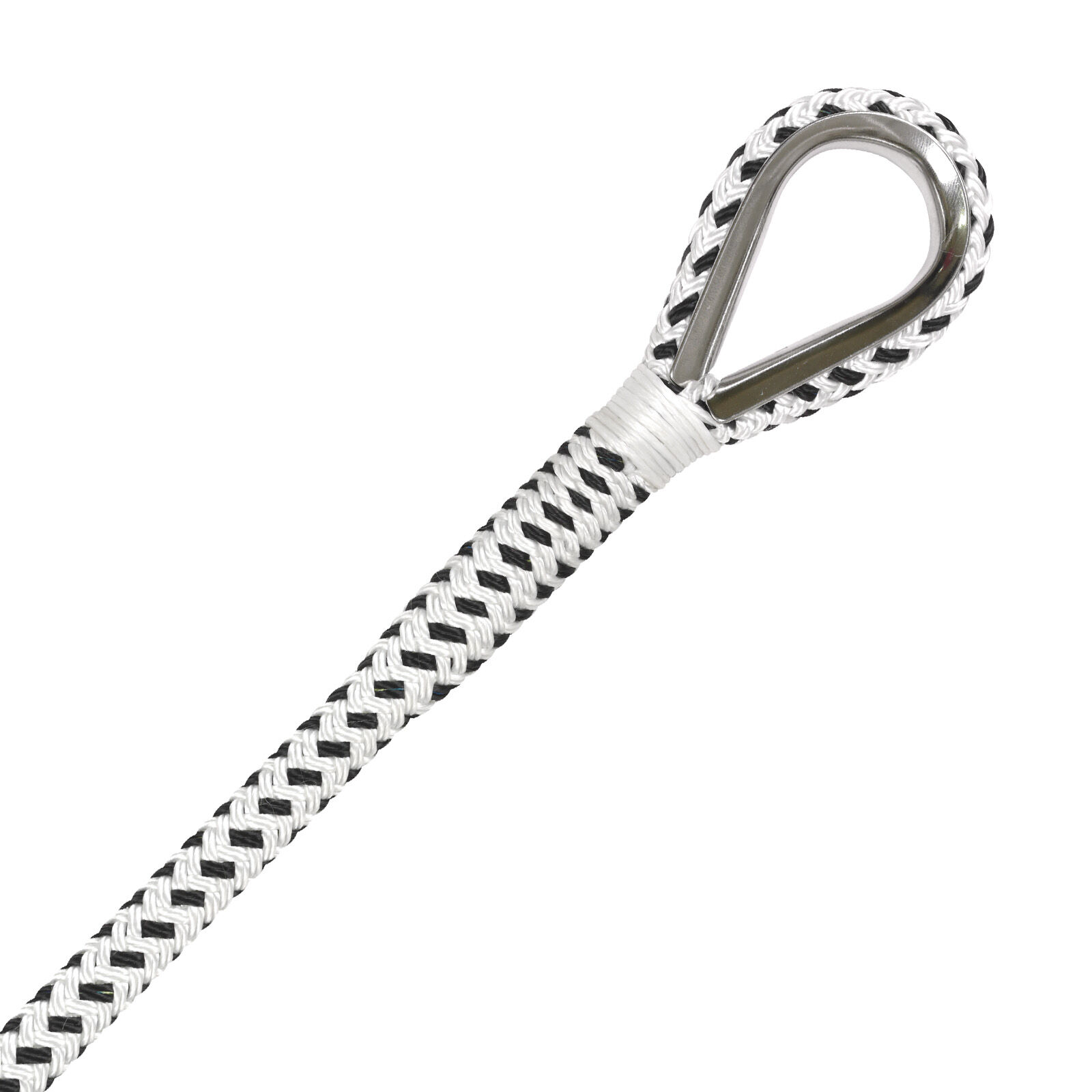
Thimble eye splice
The thimble eye splice is an eye splice with an inserted thimble. The thimble maintains the bending radius and protects the eye from chafing, for example on mooring lines and shackle points. In Dyneema, a thimble that is closed at its narrow end belongs in the eye, otherwise it deforms under load.
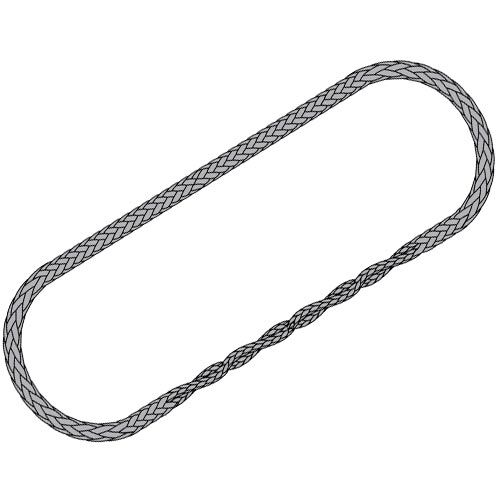
Endless splice
The endless splice closes a braided line into a ring, mainly for roller furling systems, without increasing the diameter. For polyester double braid, Polman distinguishes two versions. One works without a spliced core for a uniform diameter, the other with a spliced core for constant strength. The Furler Line follows the first variant (cover worked into itself, LIROS). Gleistein RollerTwin splices core and cover according to the manufacturer's instructions, likewise without thickening.
In laid rope there are also the short splice and the long splice (rope to rope) and the back splice. In a back splice the strands are tucked back into the rope; it secures the rope end against fraying and is not load-bearing. A whipping serves the same purpose from the outside with whipping twine.
Splicing by fibre material
The fibre determines friction, splice length, heat behaviour and knot loss. The construction determines the method.
Splicing Dyneema
Dyneema is HMPE and the most important high-modulus fibre in yacht rope. The usual uncovered yacht Dyneema is a 12-strand hollow braid, such as LIROS D-Pro. The fibre is slippery, so the splice needs a long bury length: according to Polman at least 60 times the diameter; according to DSM 60 times for coated and 100 times for uncoated Dyneema. Without a lock at the crossing point (lock splice or whipping), an unloaded Dyneema eye can be pulled out again. Knots typically retain well under 50 % of the breaking force; load-bearing ends are spliced.
Splicing polyester and polyamide
Polyester is the usual material for cruising sheets and halyards in double braid construction, such as LIROS Top-Cruising. Polyamide is more elastic and usual in mooring lines. Both tolerate knots better than Dyneema, but still fall short of a professionally made splice.
Splicing natural fibres
Natural fibres in rope include hemp as well as sisal and manila hemp. They are typically laid three-strand and are spliced with the hollow fid like other laid rope. Internal friction is high and the bury length is short. Ends are cut with a knife, not heat-sealed. Jute and cotton are natural fibres, but hardly load-bearing splicing rope.
Splicing polypropylene, aramid and Vectran
Polypropylene floats; its melting point is lower than that of polyester. Poly-hemp (Spleitex) is polypropylene staple fibre with a hemp look and is spliced like laid natural fibre rope. Aramid (Kevlar, Technora) and Vectran (LCP) are high-modulus fibres with very low elongation. Aramid does not melt and is sensitive to UV. Vectran hardly creeps and splices well in a suitable construction. The method follows the rope construction, not the trade name.
Splicing tools
Laid rope is opened with fids. Braided rope is threaded with a hollow needle or pulling needle. Selma needles push as hollow fids, D-Splicer needles grip and pull. Both suit double braid and hollow braid; the difference is the technique, not the load capacity. The marlinspike is the solid spike. A tool does not replace the rope manufacturer's splicing instructions.
| Tool | Method of working | Typical use |
|---|---|---|
| Hollow fid | Pushing, opening the strands | laid rope |
| Selma needle | Hollow needle, mostly pushing | Double braid and hollow braid |
| D-Splicer | Pulling needle with clamp | Double braid and hollow braid; often for tight or thin braids |
| Marlinspike | solid spike, opening | laid rope, wire splice, whipping |
Breaking load in splicing
Made according to the manufacturer's instructions, a splice often reaches 90–100 % of the rope's breaking load, depending on rope, diameter and splice type; splices that are too short, considerably less. A knot keeps considerably less. The planning value for knots in polyester and polyamide is approx. 50 % (Gleistein, practical handbook). The LIROS figure “up to 70 %” is a material- and knot-dependent worst case, not the design value for polyester and polyamide.
| End termination | Residual breaking force, indicative | Applies to |
|---|---|---|
| Professional splice | approx. 90–100 % | Fibre rope; Gleistein: almost the full rope strength. Practical handbook: 5–10 % loss. Samson Rope (US rope manufacturer), Class II eye splice in high-modulus ropes: 90–100 % |
| Knot, planning value | approx. 50 % | Polyester and polyamide. Gleistein: a knot weakens by up to 50 % |
| Bowline, measured | 62–66 % | 8 mm LIROS polyester, University of Strathclyde 2006 |
| Figure-eight loop, measured | 76–84 % | same test; strongest knot tested, not the planning value |
| Knot in Dyneema / HMPE | well below 50 % | slippery high-modulus fibre; load-bearing ends are spliced |
| U-bolt clip on fibre rope | unsuitable | crushes strands or braid; not a substitute for a splice |
| SAHM SYNGRIP press ferrule on fibre rope | approx. 40 % | Manufacturer guideline; the rope/ferrule pairing must be tested. Not DIN EN 13411-3 |
| U-bolt clip on wire rope, correctly fitted | approx. 80–90 % | Crosby: 80 % for clip sizes 1/8″–7/8″, 90 % for 1″–3½″; DIN EN 13411-5 |
| Swage sleeve on wire rope, correctly swaged | approx. 90–100 % | Nicopress: 95–100 % of the nominal rope breaking load. Aluminium swaging to EN 13411-3 often approx. 90 % |
Measurement on LIROS polyester (Strathclyde 2006)
Milne and McLaren tested eye splices in LIROS polyester (three-strand prestretch and double braid Top-Cruising). Values above 100 % do not mean that a splice strengthens the rope beyond its nominal breaking load; they arise when the splice breaking force is related to a separately measured rope reference value. Below a construction-specific minimum length the failure mode changes from breaking to slipping, and the breaking load then drops sharply and becomes unpredictable.
| Sample | Residual breaking force | Failure mode |
|---|---|---|
| 8 mm three-strand, at least three tucks | measured rope breaking load | Breaking |
| 8 mm three-strand, two tucks | 73 % | Slipping |
| 8 mm double braid, professionally made | 97–103 % | Breaking |
| 8 mm double braid, overlap too short | up to 15 % | Slipping |
| 6 mm and 12 mm, same splice types | well below the 8 mm values | do not transfer from 8 mm |
Splicing compared with knots and rope clamps
Splices, knots and rope clamps secure a rope end or join two ropes. They are not equivalent substitute methods.
| Feature | Splice | Knot | Rope clamp |
|---|---|---|---|
| Working principle | Interweaving within the rope | Deflection and clamping of the fibres | external clamping or swaging |
| Releasability | not releasable | releasable | releasable or permanent, depending on design |
| Residual breaking force, indicative | approx. 90–100 % | Planning value approx. 50 % (polyester/polyamide); bowline measured 62–66 % | Wire rope U-bolt clip approx. 80–90 % depending on clip size, swage sleeve approx. 90–100 %. Fibre rope: U-bolt clip unsuitable; SAHM SYNGRIP approx. 40 % |
| Passing through blocks | Endless splice and tapered splice: yes. An eye splice thickens and does not pass through blocks | usually not possible | not possible |
| Typical use | load-bearing ends on halyards, sheets, mooring lines, Dyneema, endless lines, technical ropes, natural fibre ropes, wire rope | temporary, releasable connection | Wire rope: U-bolt clip or swage sleeve. Fibre rope: SYNGRIP only with a considerably lower residual breaking force |
Knots remain where the connection has to be releasable. U-bolt clips and swage sleeves (Nicopress, MARIpress) are wire rope end terminations. SAHM SYNGRIP press ferrules are built for fibre rope, but reach only about 40 % of the rope's breaking load and do not replace a load-bearing splice.
Distinguishing splicing from related methods
- Knot
- Releasable connection by entwining. The knot crushes the rope and lowers the breaking load more than a professional splice.
- Back splice
- Strands at the rope end are tucked back into the rope so that the end does not fray. Not load-bearing.
- Whipping
- Wrapping the same end from the outside with whipping twine. It does not carry tensile load as an end termination.
- Rope clamp / U-bolt clip
- External clamping connection for wire rope to DIN EN 13411-5. Wire rope clip and thimble
- Fibre rope press ferrule
- SAHM SYNGRIP, guideline approx. 40 % of the rope's breaking load. A different entity from the splice. SYNGRIP press ferrules
- Swage sleeve
- Permanent deformation of a sleeve around wire rope (Nicopress, MARIpress). End termination, not a splice. Swage sleeves and press clamps
- Splicing service
- A service that carries out splicing. The method and the service are different entities.
- Hand splice / hand-crafted splice
- Splice made by hand in the workshop, according to rope construction and manufacturer instructions. Usual at Hamburger Tauwerk for made-up ends.
- Machine-spliced
- Splice produced by machine or in series production. A separate manufacturing method, not synonymous with a hand splice. Residual breaking load and suitability depend on the method and the rope.
- Fibre-optic splice
- Joining of optical fibres. The same German name (Spleißen), a different field.
From our workshop
In our Hamburg workshop we make eye splices, thimble eye splices and endless splices on technical fibre ropes, natural fibre ropes and wire ropes, always to the rope construction and the maker's instructions. Our made-up ends are normally hand splices, not machine-made series ends. With Dyneema, the mistake we see most is a knot where a splice should be, or an eye with too short a bury or no lock splice. Before we start, we always identify the construction (hollow braid, double braid, laid or wire); “braided” on its own does not tell us enough.
FAQ on splicing
What is splicing?
Splicing is a method of joining rope permanently or giving it an eye by working strands or braid into one another. The splice does without a knot.
Is a splice stronger than a knot?
Yes. A splice transfers the load through friction and positive locking over a longer length of the rope. A knot creates tight bends and crushing. Made according to the manufacturer's instructions, a splice often reaches 90–100 % of the rope's breaking load, depending on rope, diameter and splice type; splices that are too short, considerably less. Usual knots keep less.
Which splicing tool do I need: hollow fid, Selma needle or D-Splicer?
The hollow fid opens laid rope. The Selma needle and the D-Splicer both splice double braid and hollow braid. Selma pushes as a hollow needle. D-Splicer pulls with a clamp. The result is the same; the choice is a matter of technique and habit.
Can I use a clamp instead of splicing a rope end?
On load-bearing fibre rope ends, a rope clamp cannot replace the splice. U-bolt clips and swage sleeves are wire rope end terminations. SAHM SYNGRIP press ferrules are built for fibre rope, but reach only about 40 % of the rope's breaking load. For load-bearing ends, the splice remains the intended method.
What is the difference between laid rope, double braid and braid without a cover?
Laid rope consists of twisted strands and is spliced with the hollow fid. Double braid rope is braided: a core carries the load, a cover protects it; core and cover are tucked back into each other. Braid without a cover is a hollow braid, typically Dyneema; the end is buried in the braid. “Braided” covers the last two constructions, not laid rope. The construction types are defined under Rope construction.
Which fibre materials can be spliced?
Polyester, polyamide, HMPE (Dyneema), natural fibres (hemp, sisal, manila), polypropylene and high-modulus fibres such as aramid and Vectran can be spliced. The method follows the construction, not the fibre name alone. Dyneema needs a considerably longer bury length than laid hemp. Jute and cotton are natural fibres, but hardly load-bearing splicing rope.
Is every splice equally strong?
No. The breaking load depends on rope construction, fibre material, splice type, length or number of tucks and on execution according to the manufacturer's instructions. A splice that is too short can slip instead of holding. An endless splice in a furling line is not the same splice as an eye splice in double braid or hollow braid.
What does machine-spliced mean?
Machine-spliced means a splice from machine or series production. Hand splice means the hand-crafted execution in the workshop. Both are splices, but not the same manufacturing method; residual breaking load and suitability depend on the method and the rope. At Hamburger Tauwerk, made-up ends are as a rule spliced by hand.
How strong is a spliced rope compared with a knot or clamp?
Made according to the manufacturer's instructions, a splice often reaches 90–100 % of the rope's breaking load, depending on rope, diameter and splice type; splices that are too short, considerably less (see table above). Knots in polyester or polyamide about 50 % for planning purposes, SAHM SYNGRIP on fibre rope about 40 %, U-bolt clips on fibre rope unsuitable. On wire rope, correctly fitted U-bolt clips reach about 80–90 % depending on clip size, swage sleeves about 90–100 %.
Further reading on splicing
- Breaking load and working load
- Working stretch
- Technical fibre ropes
- High-modulus fibres
- Natural fibres
- Rope construction
- Rigging tools and whipping twine
- Practical splicing handbook (Splicing Modern Ropes)
- Halyards and sheets
- Mooring lines and anchor lines
- Ropes & fibre ropes
- Hemp rope / natural hemp
- Wire rope and accessories
- LIROS, Gleistein, D-Splicer
Sources and status on splicing
Last reviewed on .
- Gleistein: Splicing book (Spleißbuch, German). A knot weakens by up to 50 %. A splice transfers almost the entire strength potential.
- LIROS: Splicing instructions (including endless splice and wire-to-rope splice), application recommendations. A knot reduces the breaking load by up to 70 %, depending on material and knot. Catalogue values are linear, to DIN EN ISO 2307.
- Jan-Willem Polman: Praxishandbuch Spleissen (Splicing Modern Ropes). Splice 5–10 % loss, knots up to 50 %. Dyneema bury length at least 60× diameter. In the shop: Practical splicing handbook.
- K. A. Milne, A. J. McLaren: An assessment of the strength of knots and splices used as eye terminations in a sailing environment. University of Strathclyde, 2006. Tests on LIROS polyester. strathprints.strath.ac.uk/5697
- Samson Rope (rope manufacturer, USA): 12-Strand Class II Eye Splice. 90–100 % of the breaking force of the new rope in high-modulus ropes. Splicing instructions.
- The Crosby Group: Clip Warnings and Application Instructions. U-bolt clip on wire rope, correctly fitted: 80 % for 1/8″–7/8″, 90 % for 1″–3½″.
- SAHM SPLICE: SYNGRIP press ferrules, guideline approx. 40 % of the rope's breaking load. Not DIN EN 13411-3. Pairing chart.
- Nicopress: Compressed sleeve 95–100 % of the nominal rope breaking load. Efficiency of Wire Rope Connections.
- DIN EN 13411-5 (U-bolt clips), DIN EN 13411-3 (press ferrules) for wire rope end terminations.
- Further reading: Wikipedia (German): Spleiß; the Gleistein splicing book, the LIROS instructions and Polman above remain the technical authority.
This page is published by Hamburger Tauwerk Fabrik GmbH & Co. KG, Hamburg. The information is provided for orientation and general understanding. It is not a binding design specification and not an approval for any application or for safety purposes. The current product data sheet, the manufacturer's information, the applicable standard and the condition of the rope remain decisive.